When John Wayne Came to Bend: The Story of Rooster Cogburn and Riverhouse
More than 50 years ago, John Wayne and Katharine Hepburn came to Central Oregon to film a Western among the mountains, rivers and high desert landscapes of Deschutes County. The resulting movie, Rooster Cogburn, brought two Hollywood legends to Bend and left behind a few unusual connections to the local landscape—including a small cabin that once stood on the grounds of what is now Riverhouse Lodge.
From True Grit to Rooster Cogburn
Released in 1975, Rooster Cogburn was a sequel to the much better-known True Grit, the 1969 Western that made John Wayne's portrayal of U.S. Marshal Rooster Cogburn one of his signature roles.
Based on the novel by Charles Portis, True Grit follows the one-eyed, hard-drinking Cogburn as he helps a young girl, Mattie Ross, track down her father's killer. Wayne's performance earned him the Academy Award for Best Actor, and the film became one of the defining Westerns of his career.
Rooster Cogburn picks up the character years later. This time, Wayne shares the screen with Katharine Hepburn, who plays Eula Goodnight, a missionary whose father has been killed. The unlikely pair joins forces to pursue a band of outlaws, including a group that has stolen a shipment of explosives.
The movie was not the cultural phenomenon that True Grit had been, but it brought together two of the biggest stars of their generation—and brought a major Hollywood production to Central Oregon.
Why Central Oregon?
Although the story is set elsewhere, much of Rooster Cogburn was filmed in Oregon, with Deschutes County providing many of the rugged landscapes the production needed.
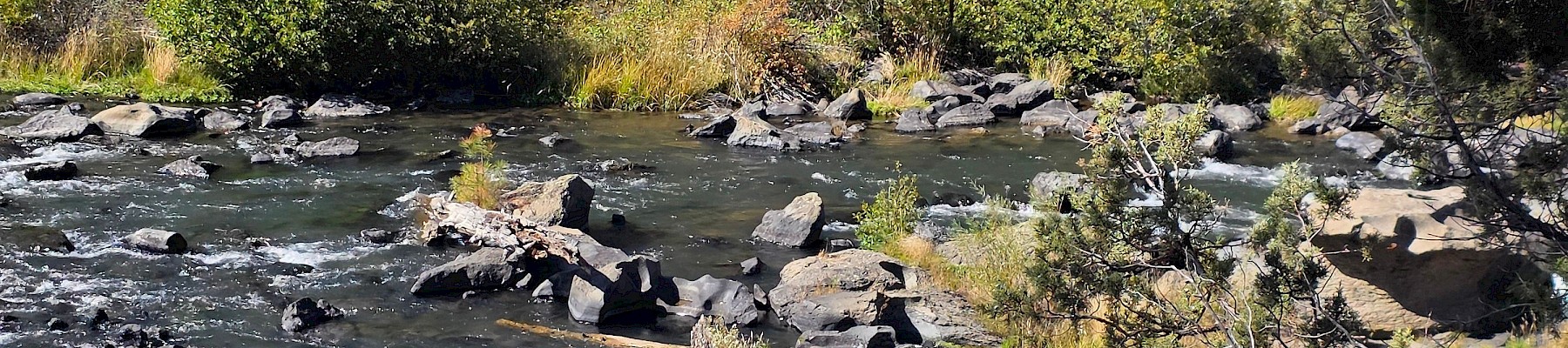
The filmmakers made use of several recognizable Central Oregon locations. Scenes were filmed along the Deschutes River, including at Benham Falls, while Smith Rock State Park provided its distinctive cliffs and rock formations. The Cascade Mountains west of Bend also served as a backdrop for the film.
The landscape was a natural fit for a Western. Central Oregon offered the combination of mountains, forests, rivers, volcanic rock and open terrain needed to create a convincing frontier setting without having to travel farther west.
The production also made its mark on the local community. While filming in Bend's Shevlin Park, the movie company provided labor to help with restoration work at the park's historic hatchery building. The production's construction crew spent two weeks on the project, turning a Hollywood location shoot into an unexpected contribution to a Bend landmark.
John Wayne and Katharine Hepburn stayed in the Sunriver area during the Central Oregon portion of filming, attracting plenty of local attention. Oregon Governor Tom McCall even paid the production a visit.
A Cabin With a Hollywood Connection
There was another, quieter connection between the production and the property that would become Riverhouse.
A small log cabin that once stood on the grounds of Riverhouse had already lived several lives before Hollywood arrived in Central Oregon. The structure dated to the early 20th century and was associated with the Old Sterns Cattle Company, having served as a mine shack along the Deschutes River south of present-day Sunriver.
During production of Rooster Cogburn, the cabin was incorporated into the filming operation. Its role in the movie was minor, but its connection to the production gave the structure an unusual place in the history of what would become Riverhouse Lodge.
The cabin's story is particularly fitting for a property that has long been connected to the Deschutes River and Central Oregon's outdoor heritage. Long before it became part of a resort landscape, the little structure belonged to an era of cattle operations, mining and early settlement along the river. For a brief period, it became part of the world of a John Wayne Western.
A Piece of Bend's Film History
Today, Rooster Cogburn offers a snapshot of Central Oregon at a very different moment in its history. Bend was considerably smaller, many of the area's now-famous destinations were still developing, and Hollywood productions could use the region's landscapes in ways that would be difficult to replicate anywhere else.
For Riverhouse, the film represents one of the property's more unexpected historical connections. The cabin's role may have been small, but it connects the resort to a period when one of America's most recognizable actors was filming just down the road—and when the landscapes surrounding Bend were being transformed, briefly, into the American West of the movies.
For anyone exploring Central Oregon's film history, Rooster Cogburn is worth revisiting. Watch it today and you'll see more than John Wayne and Katharine Hepburn. You'll also catch glimpses of the Deschutes River, Smith Rock, the Cascades and the landscape that has made Bend a destination for generations.
And somewhere within that cinematic history is a little cabin that once stood at Riverhouse—a modest piece of Central Oregon history that happened to have a Hollywood role of its own.